
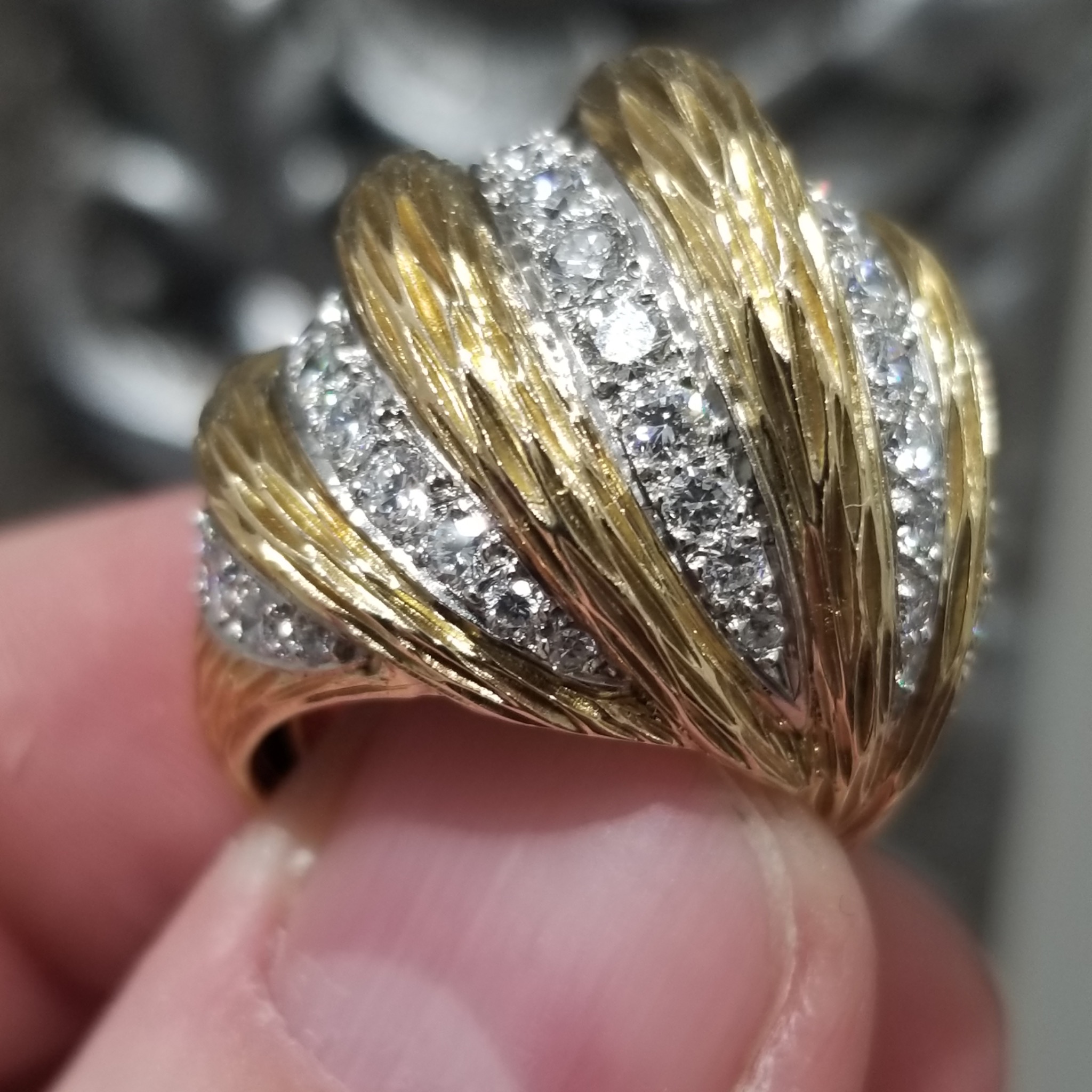
18K gold bombé ring with 39 round brilliant-cut diamonds totaling 1.25 carats, 2018. Photograph by Michael Ward.
In 1903, French chef, restaurateur, and culinary writer Georges Auguste Escoffier included more than sixty recipes for bombe glacée in Le Guide Culinaire, his definitive guide to French cuisine. The molded dessert took its name from its domed shape, which resembled a cannonball.
During the 1920s and 1930s, jewelers adopted the bombé name for rings built around a similarly rounded form. Some were smooth and architectural; others were densely set with gemstones or covered in elaborate metalwork. The bombé silhouette became a starting point rather than a single design, capable of being interpreted in an extraordinary variety of ways.
This 18-karat gold bombé ring makes an immediate impression through its scale and brilliance. Thirty-nine round brilliant-cut diamonds, totaling 1.25 carats, cover the substantial domed surface in pavé.
But looking again, the diamonds are only part of what gives the ring its character.
Deeply striated ribs of yellow gold rise from the base of the ring and sweep across the dome. They divide the pavé into irregular sections while drawing the eye upward, creating the impression of branches, leaves, or flames growing over a field of diamonds.
The texture of the gold is especially important. Rather than presenting a smooth, polished surface, each rib is marked by fine grooves that catch the light differently from the diamonds beneath it. The diamonds flash; the gold seems to flow.
That contrast transforms the ring. It is formal and organic, controlled and unruly, substantial yet full of movement. The pavé setting depends on precision and repetition, while the sweeping gold elements appear almost spontaneous.
When I first photographed the ring in 2018, its size and sparkle demanded attention. Looking at it again, what stands out is the architecture of the design: the way the gold crosses the diamond-set dome, separates it into sections, and prevents the brilliance from becoming visually uniform.
The diamonds provide the light, but the gold gives that light direction.
It is not simply a large diamond ring. It is a composition of texture, movement, and contrast—and an object that rewards another look.