
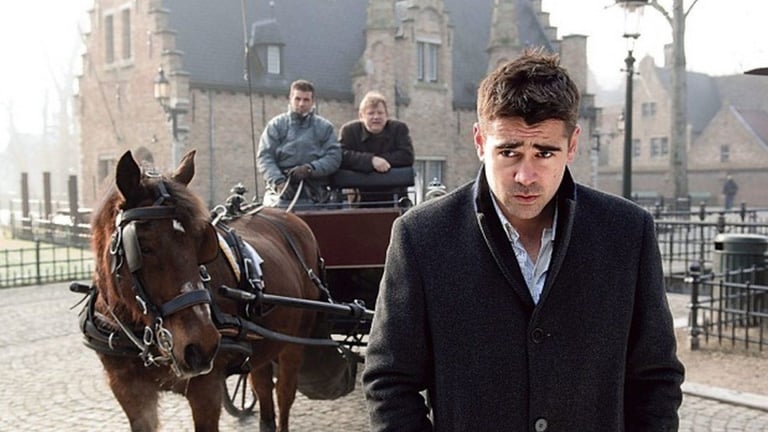
Colin Farrell and Brendan Gleeson in In Bruges. Film still © Focus Features. Used for editorial commentary.
Originally published June 30, 2008
When I wrote this review, I began by saying I wasn’t much of a Colin Farrell fan. Eighteen years later, that may be the part that surprises me most. My opinion of Farrell has changed considerably over the years, and his performance in The Penguin is what prompted me to return to this early review.
What follows is lightly edited from the original for clarity, but I have left the 2008 perspective intact.
I am not normally much of a Colin Farrell fan. I have nothing particularly against him; he has simply never been an actor who made me eager to see a movie. Tonight, though, I watched In Bruges, and he was great in it.
I had not seen a trailer or heard much about the movie beforehand. My roommates had seen it on a whim in the theater and really enjoyed it, but all I knew from them was that it had some funny scenes and that they thought it was excellent. They brought home the DVD yesterday, and tonight we put it in.
In Bruges is a dark comedy about two hit men hiding out in the Belgian city of Bruges. The dialogue has some of the same energy as Lock, Stock and Two Smoking Barrels and the wave of British and European crime films that followed it: sharp, profane, fast, and very funny.
Because the kids were in bed, we had to keep the volume fairly low, which was not ideal for a movie full of thick accents, quiet exchanges, and occasional mumbling. I know I missed some of the dialogue. Even so, there was more than enough great material to make me want to watch it again.
And this is definitely not a straight comedy.
The movie can become brutally dark. There is graphic violence, and there are a few genuinely shocking moments, but none of it feels gratuitous. The violence belongs to the story and to these characters. They are hit men, after all.
What surprised me most was how beautifully the story is constructed. The movie keeps shifting between absurd comedy, melancholy, violence, and something approaching tragedy without feeling as though it is changing genres. Things that initially seem like odd details or throwaway jokes gradually become important. The screenplay is much more carefully built than the movie first lets on.
Bruges itself is a huge part of why it works.
The city is beautiful, but Martin McDonagh does more than use it as scenery. Its medieval architecture, churches, canals, narrow streets, and almost storybook atmosphere become part of the movie’s personality. Bruges feels like another character in the story, and its strange mixture of beauty, history, and confinement gives the film an exceptional stage on which to unfold.
Ralph Fiennes is terrific as Harry, the man ultimately responsible for sending the two hit men to Bruges. I will probably always associate Fiennes with Francis Dolarhyde in Red Dragon, simply because that performance made such an indelible impression on me. Here he plays another dangerous and deeply unstable man, but Harry turns out to have considerably more dimension than the standard movie gangster. He is psychotic, certainly, but he also operates according to an oddly rigid moral code. That contradiction makes him much more interesting.
Clémence Poésy plays Chloe, the young woman Farrell’s character meets in Bruges. She was not particularly familiar to me when I first watched the film, although I knew she had appeared in the Harry Potter series. She has exactly the right quality for Chloe: beautiful, slightly mischievous, and just unpredictable enough that you are never quite certain what she is thinking. More importantly, Chloe is not simply inserted into the story as a conventional love interest. She has a few layers of her own.
Then there is Brendan Gleeson as Ken, the other hit man.
Gleeson is exceptional. Even if you do not recognize his name immediately, you almost certainly recognize his face. He somehow makes the idea of a hit man with a conscience feel completely convincing rather than clichéd. Ken is capable of violence, and we never forget that, but for him violence seems almost occupational. He can slip out of being a killer as casually as someone taking off a bathrobe. One moment he might have a gun pointed at someone; the next he could be sitting beside that same person having a pint.
That ability to hold completely contradictory qualities inside the same character is one of the things In Bruges does unusually well.
The rest of the casting is just as strong, but ultimately this feels like Martin McDonagh’s movie. He both wrote and directed it, and after seeing this, I cannot wait to see what he does next.
I had been waiting to see something that felt genuinely original, and this did.
I will watch In Bruges again, partly because I want to catch all the dialogue I missed the first time, but mostly because I enjoyed it that much. It is funny, violent, sad, strange, beautifully written, and unlike almost anything else I have seen lately.
And really, how many movies manage to make medieval Belgian architecture, existential guilt, contract killing, and an absurd confrontation involving a dwarf actor all feel as though they naturally belong in the same story?