
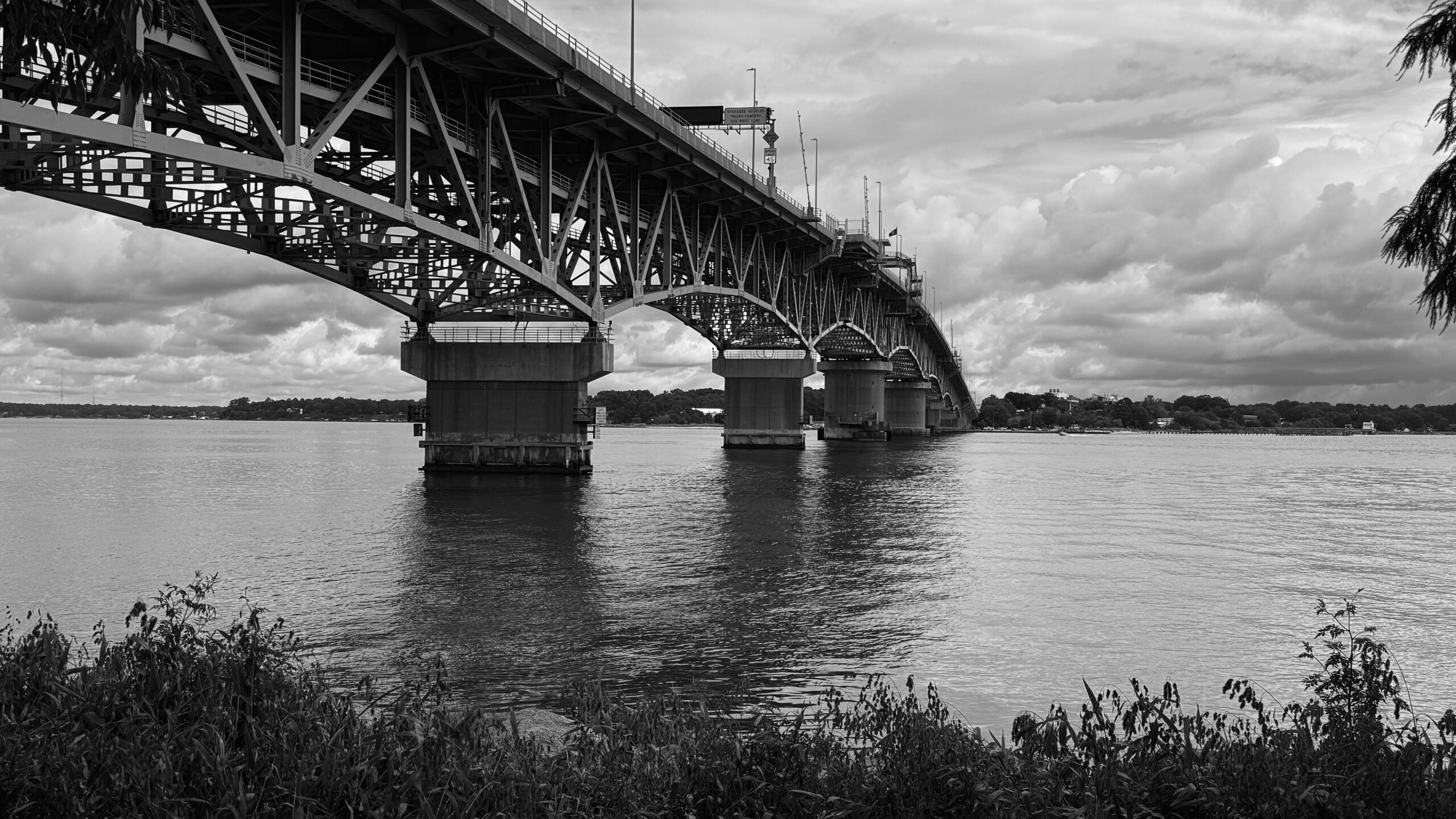
Coleman Bridge, August 22, 2026. Photograph by Michael Ward.
Long before the Coleman Bridge became part of the familiar landscape of Yorktown and Gloucester, crossing the York River meant waiting for a ferry.
For generations, the river was both a highway and a barrier. It carried ships toward Yorktown and the Chesapeake Bay, while separating the communities on either side. Travelers, farmers, soldiers, and merchants depended on ferries to make the crossing. The river could be crossed, but it could not simply be driven across.
That changed in the early 1950s.
Construction began on a permanent bridge in 1950, and on May 7, 1952, the George P. Coleman Memorial Bridge opened to traffic. The two-lane bridge stretched roughly three-quarters of a mile across the York River, creating a direct connection between Yorktown and Gloucester Point.
It was an impressive piece of engineering for its time. But the bridge had another trick built into its design.
Rather than blocking the river’s busy shipping channel, enormous swing spans could rotate horizontally, opening the center of the bridge to passing vessels. From the shoreline, watching the bridge swing open is still a strangely graceful spectacle. A massive structure carrying thousands of tons of steel simply pivots aside and gives the river back to the ships.
The bridge was named for George P. Coleman, a prominent Virginia highway official who helped shape the state’s modern road system. His name would become permanently associated with one of the most important crossings in the Tidewater region.
For more than four decades, the original bridge carried increasingly heavy traffic. By the 1980s, however, it was becoming clear that two lanes were no longer enough. The challenge facing engineers was enormous: How do you replace a bridge spanning a navigable river without shutting down one of the region’s essential transportation routes?
The answer was almost as remarkable as the bridge itself.
A new four-lane bridge was constructed in sections at Norfolk. The enormous pieces were then transported by barge up the Chesapeake Bay and into the York River. In 1995 and 1996, the old bridge was dismantled and the new structure installed.
The most astonishing part was the schedule.
Much of the critical replacement work was accomplished in just nine days.
For those watching from the Yorktown shoreline, the familiar bridge seemed to disappear and then return in a remarkably short period of time. What looked almost impossible on paper became a carefully choreographed feat of marine transportation, demolition, and heavy construction.
The new Coleman Bridge retained the two swing spans that allow ships to pass beneath it. It became wider, stronger, and better suited to the growing traffic between the Peninsula and Middle Peninsula, while preserving the characteristic silhouette that had become part of the York River landscape.
And then there were the tolls.
The original bridge operated as a toll facility until 1976. Tolls returned following the reconstruction and remained a familiar part of crossing the York River for another generation. On August 8, 2025, toll collection finally ended.
For anyone who has spent time around Yorktown, the Coleman is more than a way to get from one side of the river to the other.
It frames the landscape.
From the Yorktown waterfront, its long steel span stretches toward Gloucester Point, changing character with the weather and the hour. Morning mist can almost erase the far shore. Afternoon sunlight turns the structure into a stark geometric line against the water. At sunset, the bridge becomes a silhouette, while after dark its lights mark the river like a string of distant stars.
And occasionally, the bridge begins to move.
Cars stop. Traffic waits. A ship approaches. The great swing span turns slowly over the water, reminding everyone watching that the York River is still a working river, just as it was centuries ago.
The ferries are gone. The bridge has been rebuilt. The toll booths have disappeared.
But the river remains.
And the Coleman Bridge continues to do what it was built to do in 1952: connect two communities while allowing the York River to remain a passageway of its own.